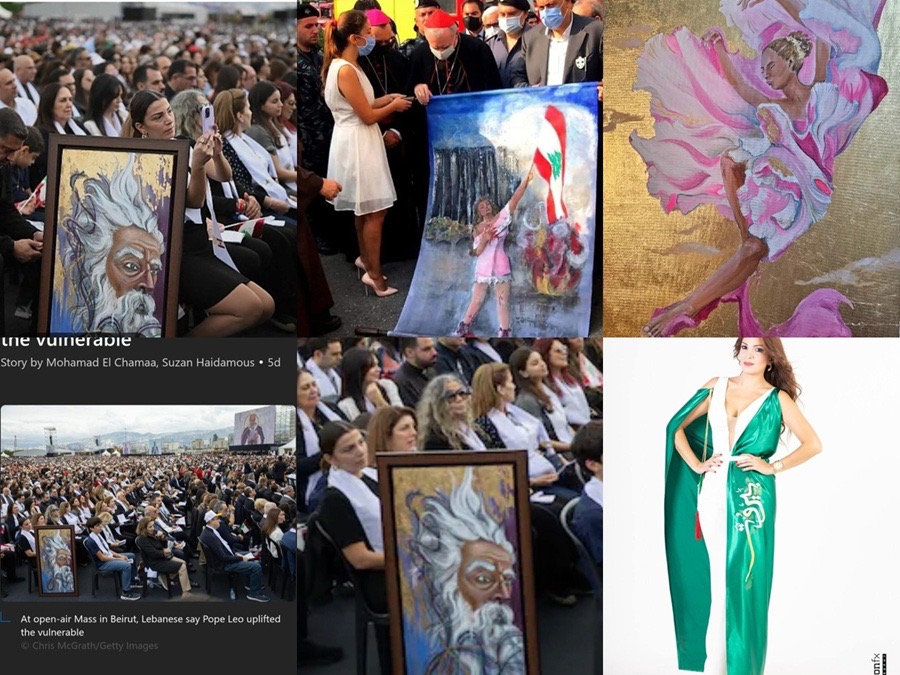
The artistic experience of Lebanese artist Pascale Harb unfolds within a path that diverges from prevailing commercial paradigms, prioritizing human, social, and national dimensions as central values of artistic practice. Her work does not approach art as a market-driven product, but as an ethical act and a form of visual testimony dedicated to human causes, national, collective awareness, , and shared memory. This approach has positioned her practice within a distinct cultural and symbolic framework.
Within cultural and social spheres, Harb is recognized for producing artworks that convey explicit and deeply rooted messages. These works are not intended for commercial circulation or conventional exhibition contexts; rather, they are presented to senior spiritual and national authorities, official institutions, and humanitarian bodies, or disseminated through media platforms dedicated to national and social discourse. Through this mode of presentation, her artworks assume a documentary function that extends beyond aesthetic value, integrating into a broader narrative of national and human history.
Art at a Historical Juncture
In her most recent national-historical work, Pascal Harb introduced a painting that functions as a powerful visual statement, rich in symbolism and encompassing social, civilizational, human, and religious dimensions. The work offers a visual interpretation of Lebanon’s historical trajectory, capturing national pain, spiritual depth, and historical continuity within a single composition. Titled Wrinkles of History, the painting received wide local and international media attention, coinciding with the visit of the Holy Father to Lebanon, and was recognized as an artistic articulation of national memory and the spiritual significance of that historical moment.
This initiative extends a humanitarian trajectory previously established by the artist, notably when she presented an artwork to His Holiness Pope Francis through an official delegation visiting Lebanon on the first anniversary of the Beirut Port explosion. That gesture carried strong symbolic weight, expressing collective grief while affirming art’s capacity to serve as a bridge between trauma and hope.
Symbolic Value and Transnational Meaning
Pascale Harb is regarded as an artist of symbolic significance, where the value of the artwork emerges from its historical context, the issues it addresses, and the institutions and figures to whom it is entrusted, alongside its accompanying media documentation. This documentation constitutes an essential component of the work itself, anchoring it within a visual archive linked to major historical and social moments in Lebanese and global consciousness.
Art as Cultural and Peace Diplomacy
Through this practice, Harb’s role evolves into that of an artist engaged in cultural diplomacy and peacebuilding. Art, in her experience, transcends individual expression to become a collective human language capable of crossing borders, cultures, and affiliations. Color and form communicate pain, hope, and empathy without the need for translation, transforming the artwork into a space of dialogue rather than division.
Her work neither denies suffering nor aestheticizes it, but presents it with clarity, dignity, and humanity, free from incitement or antagonism. In this sense, the artwork functions as a safeguard of collective memory, contributing to the prevention of recurring tragedies through awareness rather than retaliation. Pain is transformed into meaning, opening reflective spaces that invite dialogue on justice, dignity, and reconciliation.
When presented within humanitarian or spiritual contexts, or offered to international authorities, her works act as bridges between peoples, conveying Lebanon’s experiences and concerns through a universal human language. Ethical responsibility, in this framework, takes precedence over visibility or self-promotion, reflecting a conscious understanding of art’s dual potential as a force for healing or division.
Between Memory and Hope
Situated at the intersection of art and memory, Pascal Harb continues to articulate an artistic practice grounded in commitment and testimony. Painting becomes a space of remembrance, and the artistic gesture a form of visual documentation for a historical phase still unfolding within Lebanese and global awareness. While her work does not claim to provide definitive solutions, it affirms the enduring human capacity to transform suffering into meaning and to employ art as an instrument of peace.