Amman, Jordan | Wednesday, 12 August 2026
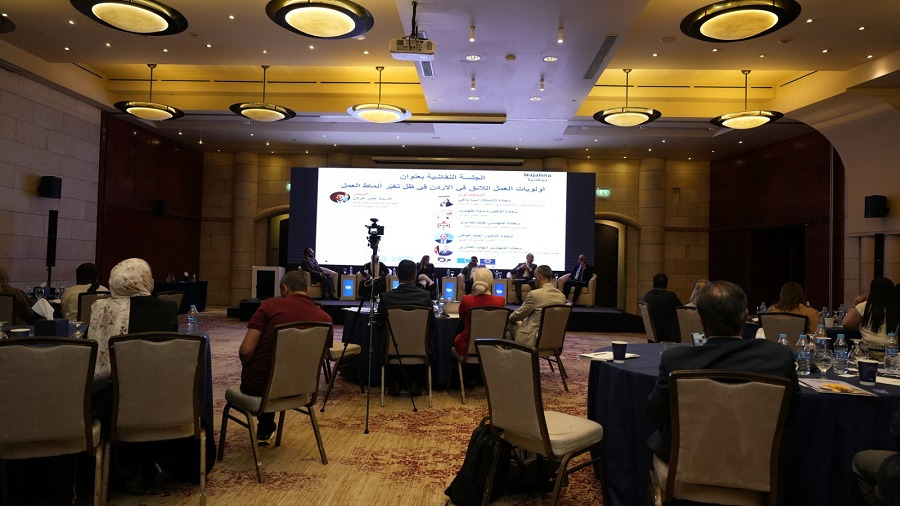
The Najahna Program, led by Plan International in partnership with the Norwegian Refugee Council (NRC), Royal Health Awareness Society (RHAS), Danish Industry, and Includovate, held a discussion on the policy paper titled “Decent Work Priorities in Jordan Amid Changing Work Patterns” on Wednesday, 12 August 2026, in Amman. The discussion brought together representatives from the government, private sector, civil society organisations, development partners, experts, and those working on labour and labour market issues.
The discussion was held as part of the Najahna Program’s efforts to strengthen dialogue around decent work priorities in Jordan, amid the rapid changes taking place in the labour market, including the expansion of flexible work arrangements and remote work, the digital economy, artificial intelligence, and automation, and their implications for labour policies, legislation, and the labour market.
During the opening remarks, Hamida Jahamah, Country Director of Plan International Jordan, said: “Over the course of five years, the Najahna project, together with its partners, has worked to support young people and enhance opportunities for education and decent work, while building a wealth of knowledge, evidence, and experience. This policy paper represents a step towards translating this knowledge into a practical discussion on reform priorities, contributing to a more inclusive and responsive decent work environment that reflects the transformations taking place in the labour market.”
The policy paper draws on the knowledge, evidence, and experience accumulated by the program over five years of implementation, in addition to a review of studies and data developed by the partners and consultations with stakeholders, experts, and practitioners. It aims to identify the most pressing reform priorities for advancing decent work in Jordan, in alignment with the Economic Modernisation Vision 2023–2033.
The paper covers a number of key areas, including the legislative and regulatory framework, social protection, wages, occupational safety and health, inclusion, gender dimensions, and the economic implications of changes in the labour market. It also presents a set of policy recommendations for government entities, the private sector, civil society organisations, and development partners, contributing to the development of policies that are more responsive to the current and future needs of the labour market.
The program included a discussion session presenting the policy paper, its methodology, key findings, and reform priorities, followed by a high-level discussion with representatives from the government, the Parliament, including the House of Representatives and the Senate, the private sector, employers, workers’ representatives, and civil society organisations. The discussion addressed several areas, including flexible work arrangements and emerging forms of work, gender dimensions and inclusion in the labour market, and the role of civil society organisations in labour policy reform, followed by an open discussion with participants.
The discussion aimed to provide a platform for dialogue among different stakeholders on reform priorities, strengthen the exchange of experiences and perspectives, and support national efforts to develop a decent work environment that responds to economic and technological changes, contributes to increased economic participation, and supports sustainable development.
The Najahna Program aims to advance the economic empowerment of youth in Jordan. It is funded by the Novo Nordisk Foundation and implemented by a consortium led by Plan International, in partnership with the Norwegian Refugee Council, Royal Health Awareness Society, Danish Industry, and Includovate, to support youth and enhance opportunities for education and decent work.